



End-of-life smart locks don’t announce themselves as clear problems that need immediate action in multi-family environments. Instead, they settle into daily operations and slowly demand more time, attention, and accommodations.
Properties continue to function, residents still gain access to units, and nothing appears quite broken enough to justify a large capital decision. Yet the work required to keep these systems running steadily increases.
How Operational Friction Accumulates Over Time
 Operators experience friction layered into routine tasks long before widespread failures. Replacement parts take longer to find. Resets become more frequent. Processes that once worked consistently begin to require extra steps. Mechanical locks are introduced on vacant units to preserve remaining smart hardware for occupied apartments, adding complexity that teams just absorb as part of the job. Over time, these adjustments stop feeling temporary and start feeling normal.
The Hidden Cost That Never Shows Up in a Budget
This stage is particularly difficult to address because it does not present itself as a traditional failure. There are no broken pieces, immediate crisis', or a major friction point that teams must deal with.
Performance Issues
As platforms age and manufacturer support winds down, vendor assistance becomes limited or unavailable. Software dependencies fall out of compatibility with current operating systems. Troubleshooting relies more heavily on institutional knowledge than documented support. Lockouts occur more often, and resident frustration increases as small issues repeat themselves. None of this happens all at once, which is why it is easy to underestimate how much effort is being spent simply to keep access systems functional.
Lost Time
Budgets are built around visible line items, and end-of-life access systems tend to distribute their cost across labor, training, resident interactions, and operational risk. Onsite teams compensate by adapting their workflows, learning the system’s limitations, and working around them. From a distance, the property appears stable. On the ground, everything takes longer than it should.
"Budgets are built around visible line items, and end-of-life access systems tend to distribute their cost across labor, training, resident interactions, and operational risk."
Limited Options
As support disappears and parts become harder to source, flexibility shrinks. Replacement options narrow. Decisions become more constrained by urgency than strategy. What once felt like a reasonable decision to wait begins to limit the paths available forward. At that point, the conversation is no longer about selecting a better technology, but about managing the consequences of having delayed a transition for too long.
Disparate Systems
Most owners and operators navigating end-of-life smart locks are not chasing new features or innovation. They are looking for systems that can be supported consistently, scaled across portfolios, and managed without relying on fragile workarounds or individual expertise. Addressing these environments one property at a time often introduces more inconsistency rather than less, making portfolio-level planning essential once systems reach this phase.
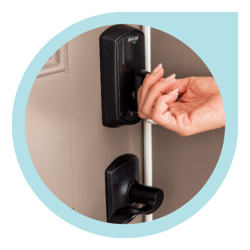 End-of-life access systems eventually force action. The only question is whether that action happens with time to plan or under pressure created by parts shortages, resident impact, or operational strain.
How Cook & Boardman Group Approaches End-of-Life Systems
At Cook & Boardman, we work with multifamily owners and operators who are facing these conditions across regional and national portfolios. Our smart lock retrofit program is designed to help teams understand what they have in place today, where risk is accumulating, and how to plan transitions in a way that aligns with real operating conditions rather than ideal ones. That includes portfolio assessments, coordinated retrofit strategies, execution at scale, and ongoing support long after installation is complete.
Access control should not become another system that onsite teams have to manage around. If end-of-life smart locks are starting to consume more time and attention across your portfolio, our team can help you evaluate next steps before those constraints make the decision for you: